

Our Impact
Education
Learn more about national homelessness stats and trends below, provided by the State of Homelessness Report from the National Alliance to End Homelessness.
View the current Annual Homelessness Assessment Report (AHAR) to Congress by The U.S. Department of Housing and Urban Development.
Learn more about the San Francisco Homeless Count & Survey from the Department of Homelessness and Supportive Housing (HSH)

The State of Homelessness: Created by National Alliance to End Homelessness, uses data from the U.S. Department of Housing and Urban Development (HUD) to provide an overview of the scope of homelessness in the U.S. on a given night , and illustrate emerging trends. Data in this report is pulled from HUD’s Point-in-Time (PIT) Count data, as well as Housing Inventory Count data.


The U.S. Department of Housing and Urban Development (HUD) last Annual Homelessness Assessment Report (AHAR), was 2024 revealing sobering new data on our unhoused neighbors. On a single night in 2024, 771,480 people – or about 23 of every 10,000 individuals in the United States – experienced homelessness. This marks an 18% increase from the previous year and the highest number ever recorded nationally, underscoring the urgent need for systemic solutions to this growing crisis.
San Francisco Point-in-Time (PIT) Count
The 2026 PIT Count took place the morning of January 29, 2026. Results not yet available.. The last PIT Count was January 30, 2024. On that night, teams of skilled outreach workers and volunteers covered the entire city of San Francisco, walking or driving through neighborhoods to count the number of people experiencing unsheltered homelessness – those sleeping on streets, in vehicles, or other places not meant for people to live.
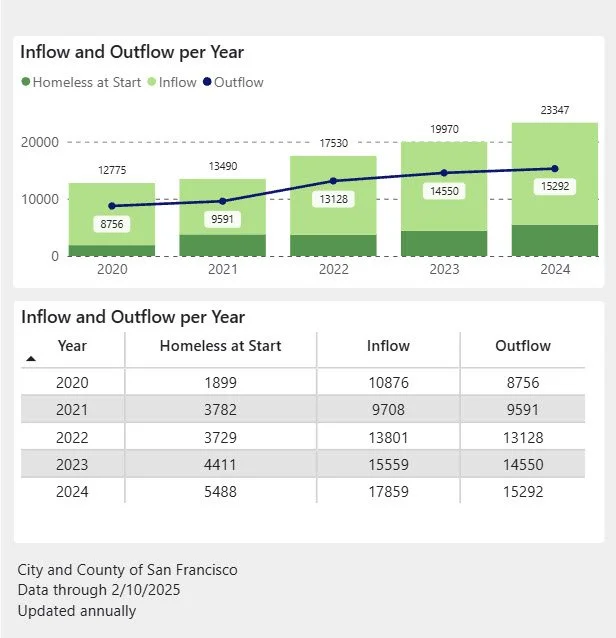
San Francisco Homelessness Trends Dashboard: Inflow and Outflow Analysis
Why this data is important
This data provides insights into how many people become homeless, how many leave homelessness, and how these trends evolve over time.
Homelessness Awareness Month held during the month of November encourages participation with HomeAid.
This is a perfect time to bring greater awareness to the needs of local communities, as well as provide a way to give back and become involved with HomeAid. You only need energy and imagination to develop your own community engagement program and bring attention to our ongoing battle to end homelessness.